Skip to content
Summarize with
Homeowners often face a tough decision when drywall damage appears on their walls. When it comes to Interior Painting Services and wall restoration, your desired look determines both your budget and your timeline.
Knowing when should you repair drywall instead of replacing it is easier than most people think. Minor damage can easily be rectified, but major structural concerns usually necessitate replacement. Many cases fall into a gray region where either option may be suitable.
Color Stars Painting LLC helped hundreds of clients navigate this exact decision. We understand walls provide the customized Interior painting services. We understand damage. And we help you make the choice that makes sense for your home.
Understanding Common Drywall Damage
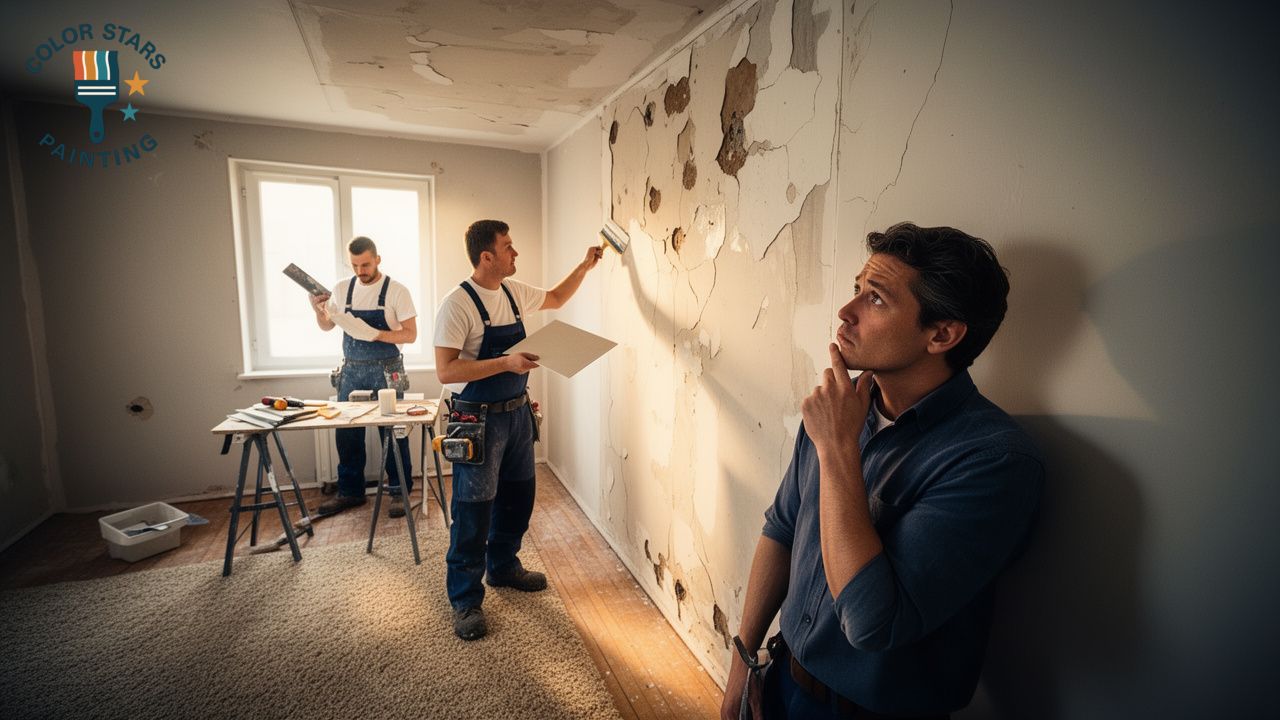
Common Drywall Damage comes in several forms. Water stains appear when moisture reaches the drywall. Cracks develop from settling and temperature shifts. Holes range from nail pops to fist sized punctures. Dents form when objects hit the wall. Mold growth indicates moisture problems underneath the surface.
Moisture damage is secretive because a simple stain might be moisture coming from a roof leak several feet away via the wall cavity. Cracks can indicate movement within the framing of your home and that is something you will want to have checked out. A hole means something hit it but it is contingent upon what was around it if the drywall itself failed or just the surface fell off.
The tricky part? The damage you see often represents a much bigger problem behind the surface. A professional assessment helps you determine whether you should repair or replace drywall based on the extent of the damage.
Signs Drywall Needs Repair
Signs Drywall Needs Repair are usually straightforward to spot. Small nail holes under half an inch are prime candidates for repair. Cracks narrower than a quarter inch across flat wall sections respond well to spackle and tape.
A single dent without surrounding crumbling stays repairable. Minor water stains from old leaks, after the moisture source stopped, can be sealed and painted over. Popped nails create small circular bumps that compound methods address in minutes.
The key indicator? The drywall paper still holds together. If you poke it with your finger and the material crumbles or peels, you’ve crossed into replacement territory. If the area feels solid, repair works.
Timing matters here too. Fresh damage is easier to assess because you know exactly what caused it. You can fix the root cause immediately, then repair the surface. Old damage requires investigation first interior painting services especially with water stains or mysterious cracks.
Signs Drywall Needs Replacement
Signs Drywall Needs Replacement are equally clear once you know what to look for. Large holes bigger than six inches across create structural weakness. Drywall that crumbles when touched has lost structural integrity.
Extensive water damage affecting more than one section of a wall means the material has absorbed too much moisture to be salvageable. Mold growth inside drywall indicates internal deterioration.
Even if there is little visible damage then the integrity of the material is weakened. This is why fire damaged areas must be replaced. Long cracks are going across several of the studs and the structure has shifted but nothing a replacement will cure. The first step you need to take is replacing the compromised drywall. Where impact holes cluster together they form weak spots.
The wall might look fine for weeks then suddenly bulge or crumble. That is the moment most people realize they should have replaced the material from the start.
Drywall Repair vs Replacement
Understanding Drywall Repair vs Replacement requires looking at more than just the damage itself. You must consider cost and durability as well as what outcome you actually want.
→ Repair works best for isolated damage. You spend less money upfront. The work finishes faster. You avoid the dust and disruption of full replacement. If the surrounding drywall stays solid and problem areas are contained, repair logic holds up.
→ Replacement makes sense when damage is extensive. Yes, it costs more initially. But it guarantees structural integrity. You won’t face callbacks in six months when the wall deteriorates further. New drywall takes the paint fresh. No permanent stains or repairs show through the new finish.
The comparison table below outlines your decision factors:
| Factor | Repair | Replacement |
|---|---|---|
| Damage Size | Under 6 inches | Over 6 inches |
| Typical Cost | $100–$300 per area | $400–$800+ per wall section |
| Time Required | 1–2 days | 3–5 days |
| Durability | 10–15 years if dry | 15–20+ years |
| Best For | Isolated damage, quick fixes | Water damage, structural concerns, large holes |
| Surface Prep | Paint quickly after curing | Requires finishing, taping, sanding |
Think of it this way: repair is a temporary fix for small problems. Replacement is permanent restoration for serious damage. Most walls need one or the other, not both.
Repairing Damaged Drywall the Right Way
Repairing Damaged Drywall involves different methods depending on your damage type. Each technique has specific steps.
→ Small holes (under 1 inch) use simple spackle. Clean the hole edges. Apply spackle with a putty knife. Sand smooth when dry. Paint over.
→ Cracks need tape and compound. Score out loose material. Apply mesh tape over the crack. Cover with drywall compound. Sand after drying. Apply a second coat if needed. Sand again. Paint.
→ Dents respond to spackling if shallow. If deep, you might need compound applied in layers, since single-application filler sinks as it dries.
→ Nail pops occur when nails push through the surface. You’ll drive the nail back in, then spackling over the raised area. Sometimes the nail pulls back out because the stud shifted—this signals a structural issue worth investigating.
→ Water stains require different treatment. Stain blocker primer prevents the stain from bleeding through paint. Multiple coats sometimes necessary. If the stain returned, moisture is still present somewhere, and repair cosmetics won’t solve the actual problem.
→ Large holes (2–6 inches): use patch kits or cut a backing board and new drywall piece. These get more involved. You’re looking at 2–3 hours of work instead of 20 minutes.
Drywall Damage Assessment Before Making a Decision
Drywall Damage Assessment should happen before you commit to either repair or replacement. Start by examining the damage closely. Is it isolated or widespread? Does it affect one wall or multiple walls? How large is the affected area?
Check the surrounding drywall. Press gently on the wall near the damage. It should feel solid and firm. Soft, spongy, or yielding areas indicate moisture problems.
Look for water stains spreading from the damage area. Stains suggest moisture moved through the wall. Finding the moisture source matters because you will repair it before fixing the drywall or the same problem recurs.
If damage resulted from water then determine whether it was a one time event or ongoing exposure. Burst pipes get fixed once. Roof leaks need roof repair. Plumbing leaks behind walls require plumbing work. Basement seepage needs waterproofing. Your repair decision depends on solving these root causes first.
The Environmental Protection Agency says moisture damage costs American homeowners about $2.5 billion a year in repairs that could have been prevented. So it is important to address the root causes.
For impact damage, assess what hit the wall. Does the impact signal a structural problem? Was it a one-time accident? Is the damage in a high-traffic area where more impacts might occur?
Consider too whether you’re doing cosmetic or structural repair. A hole in a closet needs only cosmetic fixing. A hole at eye level in your main living area might warrant replacement so the finish looks factory-fresh. Structural issues like large cracks demand professional evaluation to determine if framing problems exist.
Cost to Repair vs Replace Drywall
Cost to Repair vs Replace Drywall varies based on damage type and project scope, along with labor rates in your area.
Repair costs break down simply:
- Materials for small holes and cracks: $20–$50
- Materials for large holes: $75–$200
- Labor (if hiring): $150–$250 per hour, typically 1–3 hours for isolated damage
Replacement costs scale with the wall section size:
- Single wall section (roughly 32 square feet): $400–$600 with finishing
- Full wall (roughly 400 square feet): $2,000–$3,500
- Multiple walls: $5,000–$10,000+
These figures assume standard conditions and standard drywall. Mold remediation adds $500–$1,500 depending on extent. Structural work adds more.
Labor usually dominates the cost. Finish work—taping, mudding, sanding—takes longer than installation. Quality finishing looks invisible, which means it requires skill and patience.
Time spending matter too. Repair takes 1–2 days. Replacement takes 3–7 days depending on scope. Dust management and cleanup extend timelines including interior painting services occurs after drywall curing by adding another day or two.
The cost comparison table shows typical pricing:
| Scenario | Repair Cost | Replacement Cost | Time |
|---|---|---|---|
| Single hole, 4 inches | $150–$250 | N/A | 1 day |
| Multiple cracks, one wall | $300–$500 | N/A | 1–2 days |
| Water damage, 50 sq ft | $400–$600* | $800–$1,200 | 1–3 days |
| Mold, 100 sq ft | Not recommended | $1,500–$2,500 | 3–5 days |
An important note
Cheap repair or low cost interior painting services can ultimately cost you more in the long run. In a couple of months you will be back to square one patching damage fixes never really solving the underlying problem. Not only is it more costly to not have to redo the work but there are added expenses in supplies and labor.
Following a Drywall Replacement Guide for Severe Damage
Drywall Replacement Guide procedures ensure the job gets done right. If you’ve decided replacement is necessary, here’s what happens.
First, assessment and planning. Professionals measure the affected area. They photograph damage for documentation. They identify structural issues, moisture sources, or other problems that need addressing before new drywall goes up.
Demolition comes next. The damaged drywall gets cut away carefully so you don’t damage studs or electrical wiring behind the surface. Debris removal follows. If mold is present, remediation specialists handle this—it’s not a DIY scope.
Repair of underlying problems happens before new drywall installation. Roof leaks get patched. Plumbing gets fixed. Framing gets reinforced if necessary. Moisture barriers are installed if the area is prone to dampness.
New drywall installs on the studs. Fastening with screws (not nails) ensures the material holds securely as it settles. Joints align properly at studs for consistent finishing.
Taping and mudding follow. Mesh tape applies to seams. Joint compound spreads over tape in multiple coats. Each coat dries, then gets sanded. Finish coats make joints invisible. This work requires patience and skill. Rushing produces visible seams and imperfections.
Priming and interior painting services come last. Primer seals the new material and ensures uniform paint coverage. Two paint coats typically follow.
The total process takes 5–7 days for a standard wall section, longer for extensive damage.
Restore Your Walls With Professional Drywall Services
Color Stars Painting LLC handles both repairs and replacements with professional precision. We help you evaluate the damage. We explain your options clearly. Then we execute the work with the quality your home deserves.
If you need a drywall estimate or the best interior painting services then reach out to us. Call (512) 815-0310 or email servando033087@gmail.com. We are here to help you restore your walls and get your home looking its best.
Can I repair drywall myself?
Small holes and simple cracks work fine for DIY repair if you are comfortable with basic tools. Purchase repair kits at hardware stores. For anything larger or involving water damage, professional work prevents costly mistakes.
How long does drywall repair take?
Small repairs finish in 1–2 hours. Repairs requiring multiple compound coats take a full day or two as you let each coat dry completely. Large patches take 1–2 days.
What causes drywall cracks?
Structural settling and humidity changes or foundation movement and impact damage all cause cracks. Minor cracks from settling are cosmetic. Wider cracks or those expanding over time warrant structural inspection.
Can you paint over water stains without repair?
No. Stain blocker primer helps, but if moisture is still present, the stain will bleed through again. Fix the moisture source first, allow complete drying, then you get the best interior painting services with quality primer and topcoat.
Is mold in drywall fixable with repair?
No. Mold requires drywall replacement because the material itself is contaminated. The infected section must come out completely to prevent spore spread.
Sources
1. U.S. Department of Housing and Urban Development Resource provides historical context on drywall use in residential construction and building practices that inform repair standards.
2. U.S. Environmental Protection Agency: Official guidance on moisture control, mold prevention, and the costs of water damage in homes. Critical reference for understanding why water damage assessment precedes repair decisions.
3. National Association of Home Builders: The NAHB provides industry standards for drywall installation, finishing techniques, and maintenance practices that determine whether repair or replacement is appropriate for various damage types.